
Building Grain Silos That Last: The Steel Grade Guide for MSMEs
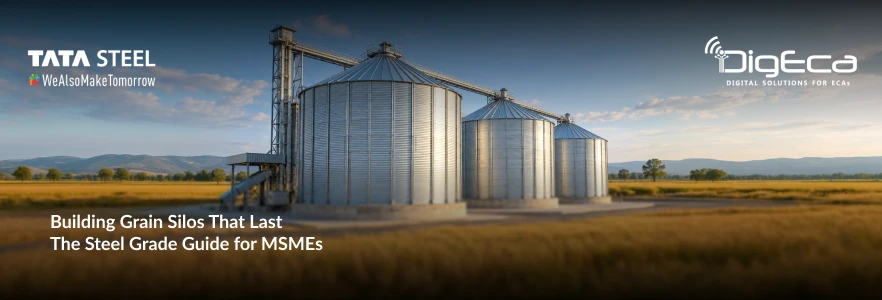
Building Grain Silos That Last: The Steel Grade Guide for MSMEs
A grain silo’s supporting frame and grain-contact surfaces perform different jobs. The frame must carry loads safely, while the shell must contain the grain, withstand its pressure and resist the storage environment. Selecting one steel specification for the entire assembly can overlook these differences.
For MSMEs sourcing steel for grain silo construction in India, grade selection should address structural performance, fabrication, corrosion protection and food-contact suitability separately. Tata Astrum Hot Rolled and Galvano coated steel are options to evaluate for relevant components. Tata Steelium Cold Rolled steel may suit selected fabricated parts where the design and protective finish permit it.
Match the Steel to the Component
Begin with the silo’s capacity, dimensions, stored grain and filling and discharge arrangements. These influence the loads and component specifications.
|
Component |
Material option to evaluate | Main selection criteria |
|
Supporting frames, base plates and gussets |
Tata Astrum HR |
Strength, thickness, connections and welding |
| Formed shell or roof panels |
Galvano coated steel |
Design strength, forming, zinc coating and joint details |
| Selected housings, covers and fabricated accessories |
Tata Steelium CR |
Formability, dimensions, finish and exposure |
| Surfaces in direct contact with grain | Application-approved material and surface system |
Food-contact suitability, cleanability and durability |
These are starting points for selection, rather than approval for a complete silo. Grain-contact suitability must be established for the supplied material and finished component.
Tata Astrum HR: Select the Structural Grade
For supporting frames and heavier fabricated components, Tata Astrum offers structural grades including IS 2062 E250 and E350 options. Select the complete grade and quality designation stated in the drawing.
E250 may suit components designed around its mechanical properties. E350 offers higher specified yield strength, but it does not automatically allow thinner members. Buckling, deflection, connection details and fabrication can govern the dimensions.
For silo shells, the designer must account for grain pressures and filling and discharge conditions. A grade selected for a support frame should not automatically be carried across to shell panels.
Order HR components with their required corrosion protection clearly defined. Uncoated structural steel and a finished, protected member are different procurement items.
Galvano: Combine Strength with Coating Requirements
Galvano offers zinc-coated sheets and coils with a zero-spangle surface, uniform zinc coating and multiple grade categories, including high-strength options.
For formed silo panels, select the mechanical grade and coating specification together. A drawing-quality grade may offer formability, but it is not automatically suitable for a load-bearing shell. Conversely, a structural grade must still accommodate the intended corrugation or bending process.
Confirm the base metal thickness, coating mass, dimensions and forming requirements. Zinc coating contributes to corrosion protection; it does not replace the required steel strength.
Plan treatment of cut edges, drilled holes, weld areas and coating damage. Joint sealing and drainage also influence whether moisture reaches vulnerable surfaces.
Where Does Cold Rolled Steel Fit?
When assessing cold rolled steel for grain silos, distinguish the primary structure from accessories and smaller fabricated parts.
Tata Steelium CRCA steel offers consistent thickness, flatness, mechanical properties and surface quality. These characteristics are relevant to parts requiring controlled forming and finishing.
A cold rolled steel coil may suit repeat production where the manufacturer has suitable processing equipment. Sheets may be more practical for smaller batches or varied component sizes.
For manufacturers evaluating cold rolled steel for grain silos manufacturing, the key question is where CR fits within the assembly. Uncoated CR should not be assumed suitable for an exposed shell or direct grain contact without an appropriate surface system and application assessment.
Specify Thickness and Surface Finish Precisely
There is no universal cold rolled steel thickness for silo components. Thickness depends on the part’s dimensions, loads, forming operation and connection details.
Record nominal thickness and its tolerance in the order. In formed parts, variation can affect tooling settings, fit and consistency during assembly.
When comparing cold rolled steel surface finish types, separate texture from defects. Roughness, scratches, dents, rust and cleanliness require different checks.
For painted or lined components, specify a surface condition compatible with the finishing process. A smooth-looking sheet alone does not establish coating adhesion, cleanability or food-contact suitability.
Establish Food-Contact Suitability Separately
Any surface touching stored grain must be assessed for its intended use. This includes the steel, metallic coating, surface treatment, sealants and any paint or lining.
Galvano has a lead-free coating, but that fact alone does not establish food-contact approval for the finished silo. Likewise, an industrial corrosion-resistant coating should not be described as food-safe without supporting evidence.
Obtain documentation appropriate to the stored grain, contact conditions and cleaning method. Food storage operations must also address applicable hygiene requirements, including equipment condition and contamination control.
Design joints and internal details to avoid inaccessible pockets of grain or cleaning residue. Check that surfaces remain intact after fabrication and can be maintained throughout service.
Inspect Before Fabrication and Assembly
Match material identification with the mill test certificate, then check the grade and reported properties against the purchase order. Inspect dimensions, surface condition and coating separately.
Trial critical bends, corrugations and connections before full production. Check panel alignment, hole positions and coating condition after forming.
At assembly, inspect sealing, fasteners and repaired surfaces. Steel selection cannot compensate for water ingress or poor storage management. Grain moisture control, ventilation or aeration where required, and regular inspection remain part of silo performance.
Source Steel Against the Material List
MSMEs can buy cold rolled steel online through DigECA and enquire with component-specific requirements. To buy Tata Steelium cold rolled steel online, share the grade, thickness, dimensions, quantity and finishing requirements.
For structural and coated components, enquire about Tata Astrum and Galvano separately. Through DigECA, we offer HR, CR and coated steel options for MSME procurement.
FAQs
Can one grade be used throughout a grain silo?
Only where the design permits it. Frames, shell panels and accessories can require different properties and thicknesses.
Does galvanised steel automatically qualify as food-safe?
No. Verify the complete supplied surface system for the intended grain-contact application.
Is E350 always preferable to E250?
No. The appropriate grade depends on the component design. Higher yield strength does not automatically justify thinner steel.
Can uncoated CR steel be used for grain-contact surfaces?
Do not assume it is suitable. Assess corrosion protection and food-contact requirements before selecting the material and finish.
Conclusion
A durable grain silo combines suitable structural grades, effective corrosion protection and verified grain-contact surfaces. Select Tata Astrum, Galvano or Tata Steelium by component, then carry those specifications through fabrication, inspection and maintenance.