
Choosing Right Steel for Heavy Vehicle Chassis | High-Strength Steel for Automotive
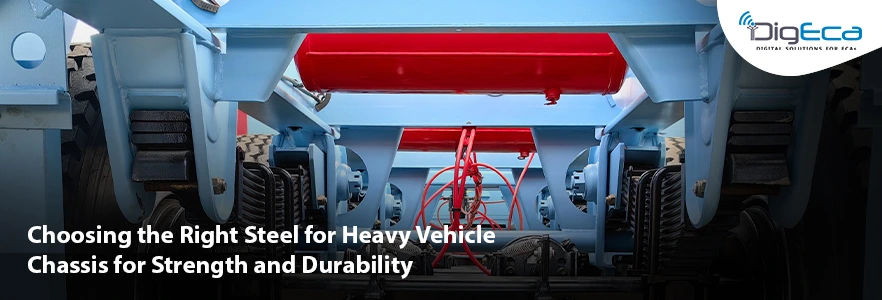
Choosing the Right Steel for Heavy Vehicle Chassis for Strength and Durability
The vehicle chassis of a heavy vehicle is the supporting system of any commercial vehicle that has high loads, the strength to overcome difficult conditions, and a high level of reliability in the long run. The choice of the appropriate steel grade is hence an essential engineering choice. The materials to be used in the manufacturing of the chassis should provide an optimal solution of strength, toughness, fatigue, and manufacturability.
With modern advancements in metallurgy and processing technologies, manufacturers today have multiple options—from traditional hot-rolled steel to advanced high-strength steel for automotive applications. The knowledge of the distinction among these materials contributes to improving the safety of vehicles, their fuel consumption, and their performance during the lifecycle.
Why Steel Remains the Preferred Choice for Metal Chassis
Steel continues to be the most trusted material for metal chassis and sheet metal chassis structures used in heavy vehicles such as trucks, buses, trailers, and off-road equipment. The main reason why it has been widely used is due to:
- High load-bearing capacity
- Superior shock resistance.
- Superior fatigue strength
- Economical compared to other media.
- Welding, forming, and fabrication Ease.
- Sustainability and recyclability.
Tata Steel offers manufacturers dependable steel solutions in the form of DigECA, which is specifically developed to handle high-demand automotive and industrial usages.
Hot-Rolled Steel: The Traditional Choice for Heavy-Duty Chassis
Hot-rolled steel is commonly used for large structural members in heavy vehicle chassis due to its robustness and cost-effectiveness. It is made through rolling of steel at high temperature, and thus it becomes easier to roll into thicker sections that are suitable for frames, rails, and beams.
Key Benefits of Hot-Rolled Steel for Chassis:
Excellent formability: It is suitable for bigger and heavier parts.
- High weldability: Makes it easier to make fabrication on more extended chassis frames.
- Good mechanical strength: Operates well when it is loaded heavily.
- Mass production is cost-effective.
Hot-rolled steel is typically applied in ladder frames, side members, and cross members, where dimensional tolerances are not as critical but durability is essential.
<H3>Cold-Rolled Steel: Precision and Surface Quality
Cold-rolled steel undergoes processing at room temperature, which enhances its dimensional accuracy and surface finish. Although it is more typically applied to the exterior body of a car, it can also be used for some chassis parts where a tighter tolerance is required.
Advantages of Cold-Rolled Steel in Chassis Applications:
- Higher strength than conventional hot-rolled steel
- Finishing of components with a tight fit.
- Increased conformity of thickness and mechanical characteristics.
- Increased fatigue capabilities of selected chassis components.
Cold-rolled steel is widely used for sheet metal chassis components such as brackets, mounting systems, and reinforcement structures.
High Strength Steel in the automotive application: the new standard.
High-strength steel in the automotive industry has gained popularity as automotive companies are concentrating on the enhancement of payload capacity with a decrease in the weight of the automobile. With these high grades, the ratios of strength to weight are enhanced to suit heavy vehicle chassis.
Essential Features of the High-Strength Steel (HSS):
- Increased tensile strength to have better load-bearing capacity.
- Better fatigue resistance for long.
- Improved crash force attenuation that enhances vehicle safety.
- Allows loss in weight without reducing the durability.
The steel is now high-strength in components of the chassis that are the most important, like extended members, suspension systems, cross beams, and reinforcements. The fact that it is tough and does not weigh much enables a manufacturer to attain high fuel efficiency and improved performance.
DigECA by Tata Steel provides high-grade steel forms that are specifically designed to serve such purposes, where quality and ideal engineering performance are assured.
The selection of the Right Steel: The main things to consider
In choosing the appropriate steel material that can be used in a heavy vehicle chassis, manufacturers will have to consider the following:
1. Load Requirements:
The materials used in heavy trucks and buses must be able to sustain high loads in terms of both static and dynamic loads. Hot-rolled steel and high-strength steel are preferred choices depending on the load distribution and design complexity.
2. Environmental Exposure:
The chassis materials should not be subject to moisture, road salts, or other extreme climatic conditions. High-strength steel and well-coated cold-rolled steel provide better corrosion resistance.
3. Manufacturing Processes:
Considerations are formability, weldability, and machinability. Hot-rolled steel is ideal for simpler, thick structures, while cold-rolled steel suits precision parts.
4. Weight Optimization:
High-strength steel in automotive design enables a reduction of weight, resulting in more fuel efficiency and carrying capacity.
5. Cost and Availability:
A balanced choice will make certain that the performance demands are fulfilled without increasing the cost of production. DigECA by Tata Steel proposes a wide variety of solutions that uphold this equilibrium.
Conclusion
The selection of a suitable steel to use on a heavy vehicle chassis entails studying the characteristics of materials, production requirements, and expectations. Whether using hot-rolled steel for robust structures, cold-rolled steel for precision components, or advanced high-strength steel for automotive applications, the correct choice ensures superior durability, strength, and long-term reliability. Tata Steel's program, known as DigECA, helps manufacturers to get a high-quality steel solution with industrial grade, which is designed to suit the heavy vehicle requirements of demand.
FAQs:
1. What is the best steel for a chassis?
High-strength steel is considered the best for chassis applications due to its excellent durability, load-bearing capacity, and ability to reduce vehicle weight.
2. What is the best material for a chassis?
Steel remains the most preferred material for chassis manufacturing because of its strength, weldability, cost-effectiveness, and long-term performance.
3. Which metal is used for the chassis?
Steel—specifically hot-rolled steel, cold-rolled steel, and high-strength steel—is the most commonly used metal for chassis production.
4. Which type of steel has the highest strength?
Advanced high-strength steel (AHSS) offers the highest strength among commercially used automotive steels.