
GP Skin Pass Steel for Electrical Panels and Control Boxes: What Fabricators Need to Know
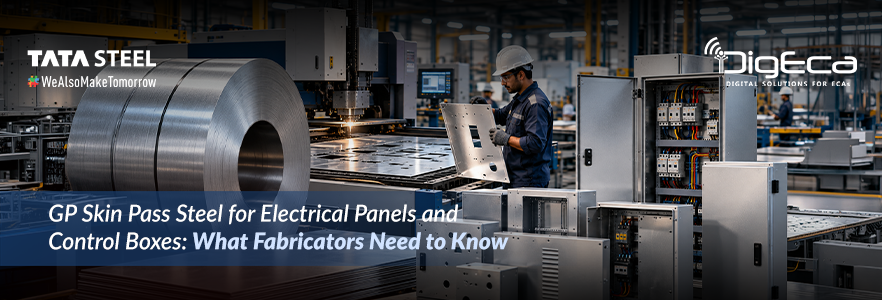
GP Skin Pass Steel for Electrical Panels and Control Boxes: What Fabricators Need to Know
A control-box door that does not sit flat can create trouble long before installation. Hinges may misalign, gaps can appear around the enclosure and the painted surface may show waves or marks. Even when the design and tooling are correct, inconsistent sheet quality can affect the final fit and finish.
For electrical-panel fabricators, steel selection is about more than thickness and price. Flatness, surface consistency, bendability, coating quality and dimensional control all influence how smoothly the material moves through cutting, punching, bending, welding and painting.
This is where GP skin pass steel becomes relevant.
What does GP skin pass mean?
GP stands for galvanised plain. It refers to steel protected by a zinc coating, which reduces direct exposure of the base steel to moisture and corrosive conditions.
Skin passing is a light rolling operation carried out on the coated steel. It improves surface uniformity and flatness while supporting more consistent fabrication behaviour. On DigECA, Tata Steel Galvano appears under the catalogue description “GP Skin Pass 0 Spangle”.
The zero-spangle surface has no prominent zinc crystal pattern. This gives the sheet a smoother and more consistent appearance, which is valuable for enclosures that will be painted or powder-coated.
However, skin passing does not determine every aspect of performance. A buyer must still specify the correct base grade, zinc coating mass, thickness, surface treatment and dimensions.
Why panel fabricators consider skin pass steel
Electrical panels and control boxes often look simple from the outside, but their production involves several operations. A typical sheet may be punched for switches and cable entries, bent along multiple edges, welded at corners and finished with paint or powder coating.
Suitable skin pass galvanized steel can support these processes in several practical ways.
Flatter doors and enclosure walls
Large, flat surfaces make waviness easy to notice. Poor flatness can also affect door closure, gasket contact and alignment between adjoining parts.
A skin-passed sheet provides a more even starting surface for cabinet walls, front panels and doors. Fabricators should still check the thickness, width and flatness tolerances required by the drawing.
A consistent base for painting
Electrical enclosures are often painted or powder-coated to meet appearance and service requirements. Surface variation beneath the coating can remain visible after finishing, especially on larger doors and panels.
A smooth, zero-spangle surface creates a more uniform base. Final coating quality will also depend on cleaning, degreasing, pretreatment, paint chemistry and curing conditions. The material specification and finishing process must be compatible.
Cleaner bending and forming
Panel production commonly involves right-angle bends, channels, flanges and return folds. The selected steel grade must withstand these operations without cracking or creating an unacceptable bend surface.
CQ may suit simple fabrication, while DQ can be considered for parts with more demanding forming. The choice should be based on bend radius, thickness, number of bends and component geometry rather than the grade name alone.
Consistent punching and assembly
Control boxes can contain several cut-outs for meters, displays, switches, fans, glands and cable routing. Variation in thickness or flatness may affect punching accuracy and the way different parts fit together.
Consistent material can reduce adjustment during assembly, but tool clearance and maintenance remain equally important. The press setup should match the actual sheet thickness and coating condition.
Where can it be used?
Galvanized steel for electrical panels may be considered for:
- Distribution-board enclosures
- Switchgear cabinets
- Meter boxes
- Control-panel doors
- Internal partitions
- Cable-management boxes
- Junction boxes
- Industrial electrical cabinets
The same material may also work as galvanized steel for control boxes used with machinery, pumps, HVAC systems and factory equipment. The final specification will depend on whether the enclosure is installed indoors, outdoors or in a humid or industrial environment.
For visible doors and painted enclosure walls, smooth zero-spangle material is often preferred. For concealed internal parts, appearance may carry less weight than coating mass, strength and fabrication performance.
The grade must match the fabrication work
The phrase GP steel for electrical panels does not identify a complete material specification. Two GP sheets of the same thickness may respond differently during bending or forming if their base grades and mechanical properties differ.
Before selecting a grade, review:
- Whether the component is flat or formed
- The smallest bend radius
- The number and direction of bends
- The depth of any drawn section
- Punching and welding requirements
- Required load-bearing capacity
- Appearance after painting
Avoid selecting a more formable grade automatically. If CQ can produce a simple panel consistently, a deeper-drawing grade may add little value. If repeated cracks appear during bending, the grade, bend radius, coating condition and tooling should all be investigated.
Coating mass and service conditions
The zinc coating on a galvanized steel sheet for electrical panels provides corrosion protection, but the required coating mass depends on the service environment.
An indoor control box in a dry plant does not face the same conditions as an outdoor enclosure exposed to rain, humidity or industrial pollutants. Cut edges, punched holes and welded areas also require attention because fabrication can disturb the protective coating.
Ask the customer or project team to confirm:
- Indoor or outdoor installation
- Exposure to moisture or chemicals
- Expected service life
- Required zinc coating mass
- Painting or powder-coating system
- Passivation requirement
- Any applicable project or customer standard
Do not rely only on the visible appearance of the zinc surface when deciding corrosion performance.
Buying sheet or coil
A galvanized steel sheet can suit fabricators working with varied enclosure sizes, smaller batches or standalone cutting and bending equipment. Cut-to-length material may also simplify handling and stock control.
Coil can suit larger production runs when the facility has decoiling, levelling and blanking equipment. Before buying coil, consider storage, lifting capacity, line width, minimum quantity and expected material yield.
The lower price per tonne is not always the better commercial choice. Compare usable output, scrap, handling time, line stoppages and rejection rates.
Raise a more complete enquiry on DigECA
A quotation can only be as accurate as the requirement shared. When raising an enquiry, include:
- Electrical-panel or control-box application
- Required steel grade
- Thickness, width and length
- Sheet, slit-coil or full-coil requirement
- Zinc coating mass
- Zero-spangle surface requirement
- Passivation and painting process
- Quantity and delivery location
- Required delivery date
Our Tata Steel Galvano range offers GP skin-pass, zero-spangle coated steel with the surface finish, flatness, forming performance and corrosion protection required across modern fabrication applications.
To buy galvanized coated steel MSME online, first register on DigECA. You can then select the relevant catalogue option and raise an enquiry for a quotation based on your specifications and current product availability.
Frequently asked questions
What is the difference between regular GP steel and GP skin pass steel?
GP skin pass steel undergoes a light rolling operation that improves surface uniformity and flatness. The full performance difference also depends on the base grade, zinc coating mass and surface treatment.
Is zero-spangle steel suitable for painted electrical panels?
Yes. Its smooth and uniform surface makes it suitable for painted or powder-coated panels. Proper cleaning, pretreatment and curing are still required for a consistent finish.
Which grade should be used for an electrical control box?
CQ may suit flat parts and simple bends, while DQ may suit more demanding forming. Confirm the choice against the drawing, bend radius, thickness and fabrication trial.
How can I request a quotation on DigECA?
Register on DigECA, select the relevant coated-steel product and raise an enquiry with your grade, dimensions, coating mass, quantity and delivery details. Our team will review the requirement and provide a relevant quotation.
Conclusion
Flatness, surface finish and bendability directly affect how an electrical enclosure looks and assembles. Skin-passed GP steel can provide a suitable starting point, but it must be ordered with the correct grade, coating mass, dimensions and surface treatment.
Define these details around the finished panel rather than purchasing a generic GP sheet. A clear specification can reduce corrections on the shop floor and produce more consistent control boxes across every batch.