
Hot rolled steel used in cylinder manufacturing for low pressure liquefiable gases
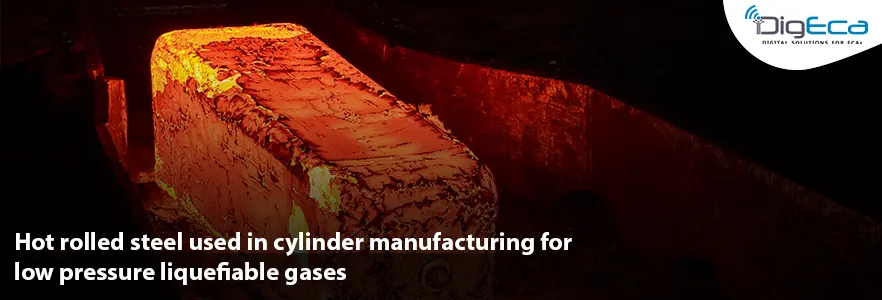
Hot rolled steel used in cylinder manufacturing for low pressure liquefiable gases
Steel is the prominent choice for cylinder manufacturing due to its unmatched durability, affordability, and safety in high-pressure applications.
Strength and Durability – Steel cylinders can withstand high pressure and rough handling. They are more impact-resistant compared to other materials.
Cost-Effectiveness – Steel is more economical in terms of manufacturing, maintenance and recycling.
Types of steel used in cylinder manufacturing
In the present scenario, for the manufacturing of cylinders used in storing low pressure liquefiable gases, the Bureau of Indian Standards (BIS) has specified two steel standards that can be used.
The two BIS standards for steel used in cylinder manufacturing are:
IS 6240: One of the applicable standards for the manufacturing of welded low carbon steel cylinders with a water capacity exceeding 5 litres, designed for storing low-pressure liquefied gases.
This standard covers cylinders intended for:
• LPG (Liquefied Petroleum Gas)
• Non-toxic gases (Other than LPG)
• Toxic and corrosive gases
IS 15914: This is also an applicable standard for the manufacturing of welded low carbon steel cylinders with a water capacity exceeding 5 litres, designed for storing low-pressure liquefied gases.
This standard covers cylinders intended for LPG (Liquefied Petroleum Gas) only.
These standards define the chemical composition, mechanical properties, and testing requirements to ensure the steel meets the necessary performance criteria for gas storage.
Key Properties Required for Cylinder Steel
The key properties required for manufacturing cylinders for low pressure liquefiable gases, as per the relevant BIS codes include:-
Tensile test
It involves straining a test piece by tensile force, generally to fracture, for the determination of one or more of the mechanical properties. A uniaxial force is applied to a steel specimen until it fractures, measuring how the material responds under tension.
Bend Test
This method is used for determining the ability of metallic materials to undergo plastic deformation in bending.
It consists of submitting a test piece of round, square, rectangular, or polygonal cross-section to plastic deformation by bending, without changing the direction of loading, until a specified angle of bend is reached.
Strainage Embrittlement Test
Strainage embrittlement refers to the loss of ductility and toughness in steel due to plastic deformation (strain) followed by aging at elevated temperatures. This embrittlement occurs due to the precipitation of impurity elements (such as phosphorus, nitrogen, or carbon) along grain boundaries, leading to reduced fracture resistance.
Erichsen Cupping Test
A standard test method for determining the ability of metallic sheets and strips having a thickness from 0.1 mm up to 2 mm and a width of 90 mm or greater to undergo plastic deformation in stretch forming.
Forming an indentation by pressing a punch with a spherical end against a clamped test piece between a blank holder and a die until a through crack appears. The measured depth of the indentation is the result of the test based on the movement of the punch.
Grades of steel used in cylinder manufacturing:
| Standard | Chemical Composition (Ladle analysis as per IS 228) | Tensile Testing (IS1608 & EI% as per IS 3803) | Normalizing (⁰C) | ||||||||
| C% | Mn% | Si% | S% | P% | Al% | YS (MPa) | TS (MPa) | EI% 5.65√S0 | Bend | ||
| IS 6240 Gr 240 | Max. 0.16 | Min 0.30 | Max. 0.25 | Max. 0.025 | Max. 0.025 | Min 0.020 | Min 240 | 350-450 | 25 | t | 670±20 |
| IS 15914 HS235 | Max. 0.16 | Min 0.30 | Max. 0.25 | Max. 0.025 | Max. 0.025 | Min 0.015 | Min 235 | 360-460 | 25 | - | 920-960 |
| IS 15914 HS265 | Max. 0.18 | Min 0.40 | Max. 0.30 | Max. 0.025 | Max. 0.025 | Min 0.015 | Min 265 | 410-510 | 22 | 890-930 | |
| IS 15914 HS295 | Max. 0.19 | Min 0.50 | Max. 0.35 | Max. 0.025 | Max. 0.025 | Min 0.015 | Min 295 | 450-560 | 20 | 890-930 | |
| IS 15914 HS345 | Max. 0.20 | Min 0.70 | Max. 0.45 | Max. 0.025 | Max. 0.025 | Min 0.015 | Min 345 | 490-610 | 18 | 880-920 | |
Future Trends in Cylinder Steel
A. Earlier, LPG cylinders were manufactured using raw materials conforming to IS 6240.
However, with recent advancements, cylinder manufacturers are now promoting IS 15914 as the preferred material. Cylinders made from IS 15914 are lighter compared to those manufactured under IS 6240, offering improved efficiency.
Please refer to the table below for a detailed comparison.
|
Gas Weight (Kg) |
IS6240 Gr 240 (RM Thk.) |
IS15914 HS 345 (RM Thk.) |
|
5 |
2.2 mm |
2 mm |
|
14.2 |
2.9 mm |
2.20/2.30 mm |
|
19 |
2.9 mm |
2.5 mm |
B. Use of composite material for household LPG Cylinder
These cylinders have a three-layered construction. It is made up of a blow molded High-Density Polyethylene (HDPE) inner liner, covered with a Composite layer of polymer-wrapped fiber glass and fitted with a HDPE outer jacket.
These new age composite cylinders have multiple advantages over the existing steel cylinders:
• They are light weight: the tare weight of a composite cylinder is half of its steel counterpart.
• They have a translucent body which helps customers to accurately check the LPG level against light. This will help customers plan their next refill easily.
• They are rust-free, and do not corrode. This reduces the chances of leaving stains and marks on surfaces.
• They are aesthetically designed which makes them visually appealing and ideal for modern kitchens of today.
• They are safer to use than being explosion proof.
Conclusion
With a wide selection of hot rolled steel, cold rolled steel, and other precisely manufactured products to satisfy various industrial applications, DigECA is your reliable partner for premium steel solutions. With a dedication to quality, DigECA blends sustainability and innovation to guarantee each product has exceptional strength, performance, and longevity. Whether you're designing complex cold-formed steel sections or constructing massive hot-rolled steel structures, DigECA offers dependable solutions that are customized to meet your project's needs. For unrivaled quality, industry knowledge, and innovative technology that propels achievement, contact DigECA.
This article has been contributed by our technical expert Akash Jaiswal from Product Application Group (PAG) team.