
How Cold Rolled Steel Powers India’s Modern Infrastructure
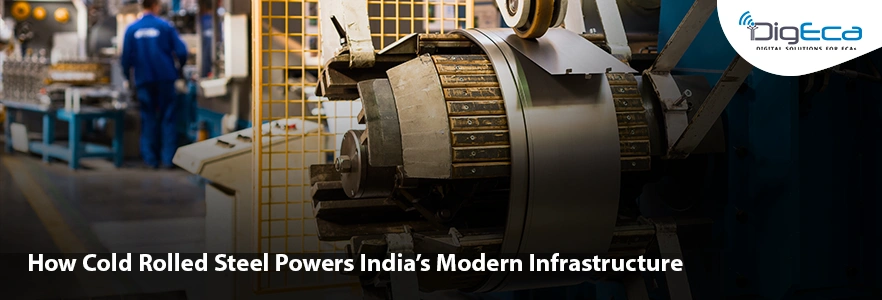
How Cold Rolled Steel Powers India’s Modern Infrastructure
Infrastructure isn’t just about what gets built; it’s about how long it lasts, how well it performs, and how intelligently it’s designed. And if there’s one material quietly driving the transformation of India’s bridges, metros, solar parks, smart cities, and power grids, it’s cold rolled steel.
At first glance, steel is steel. But cold rolled steel brings something extra to the table: precision, resilience, and the kind of finish today’s engineering demands. Whether you’re talking about a 22-kilometre sea bridge or a solar panel mounting structure in a remote power plant, cold rolled steel is increasingly the go-to choice. Here’s why.
What Sets Cold Rolled Steel Apart?
Cold rolled steel is made by taking hot rolled steel and running it through rollers again at room temperature. That cold pass does a few critical things:
- Increases tensile strength
- Improves surface finish
- Delivers tighter dimensional tolerances
- Reduces surface impurities
- Enhances corrosion resistance
These aren’t minor upgrades. They’re foundational cold rolled steel properties that make it ideal for precision infrastructure work.
In short, you get a material that’s not only stronger but also more predictable and cleaner to work with. That makes it a solid choice across infrastructure categories, from skyscrapers and metros to solar and power systems.
Where It’s Showing Up: From National Landmarks to Daily Commutes
1. Steel That Keeps Bridges Standing and Beautiful
Let’s look at the Chenab Rail Bridge in Jammu & Kashmir, now the tallest railway bridge in the world. At 359 meters above the river, it’s taller than the Eiffel Tower. Over 16,000 tonnes of steel went into its structure, and much of it needed to deliver both extreme tensile strength and corrosion resistance.
Projects like this demand high-performance cold rolled steel grades in India, which can meet both mechanical and environmental stress requirements.
The Mumbai Trans Harbour Link (MTHL) is another example. With over 100,000 tonnes of steel used, cold rolled sections provided structural consistency and fatigue resistance across the 22-km span, ideal conditions to showcase the benefits of cold rolled steel.
2. Smart Transit Runs on Smart Steel
Metro systems from Delhi to Pune use cold rolled steel across their stations, railbeds, and internal systems.
Why? Because of the material’s defining strengths:
- Tighter tolerances for rail alignment
- Reduced wear on moving parts
- Resistance to rust in coastal or polluted urban zones
- Uniform structure that ensures less vibration and more stability
All of these are core cold rolled steel properties that make it essential for modern transport infrastructure.
3. The Backbone of Buildings That Reach Higher
India’s urban centres are going vertical. From luxury housing in Mumbai to startup campuses in Hyderabad, builders need structural materials that are light, strong, and reliable.
Thanks to its high strength-to-weight ratio, cold rolled steel enables:
- Faster prefab construction
- Higher seismic resistance
- Sleeker architecture with fewer bulky columns
- Longer service life with less maintenance
In this space, cold rolled steel uses go far beyond structural skeletons. It’s showing up in facade systems, internal framing, HVAC support structures, and even elevator casings, anywhere precision and load-bearing strength are key.
4. Power Infrastructure: The Silent Workhorse
The role of cold rolled steel in India’s energy grid is often overlooked but it’s crucial. One specialised type, Cold Rolled Grain-Oriented (CRGO) steel, is the core material used in transformers, electrical motors, and high-efficiency generators.
With power demand growing, India’s dependence on imported CRGO steel has become a bottleneck. Building up domestic capacity for these high-performance cold rolled steel grades in India is now a strategic need, not just a manufacturing goal.
Solar and Steel: Built to Last
Let’s talk about solar. The next time you walk through a large-scale solar park in Rajasthan, Tamil Nadu, or Gujarat, look closely at the frames and mounting structures. There’s a good chance they’re made from cold rolled steel, and for good reason.
Here are just a few of the benefits of cold rolled steel in solar:
- Smooth, uniform finish that resists dust and corrosion
- Consistent thickness and sizing for easy installation
- Greater strength under wind and seismic loads
- Excellent load distribution across extended spans
For solar developers, this adds up to more efficient installs, fewer maintenance issues, and greater ROI over 25+ years.
Rising Demand, Growing Capacity
India’s structural steel market, including cold rolled steel, is set to grow fast. From $15.7 billion in 2023, it’s expected to reach nearly $24 billion by 2028.
What’s driving this surge?
- ₹111 lakh crore National Infrastructure Pipeline
- Gati Shakti and Bharatmala transport corridors
- Smart city construction and high-rise expansion
- Solar energy infrastructure
- Data centres, logistics hubs, and tech parks
All of these rely on high-performance cold rolled steel grades in India that meet evolving project specifications. And they all demand materials that shorten build time and extend asset life—two core benefits of cold rolled steel.
Indian Manufacturers Are Leading the Charge
Major players like Tata Steel are ramping up production of cold rolled steel for industrial and infrastructure use. Tata Steel’s downstream units produce custom cold rolled steel grades in India tailored to sectors like auto, energy, and telecom.
These companies are also investing in low-emission steelmaking, aligning with India’s climate commitments while supporting infrastructure at scale.
Choose Cold Rolled Steel for Better Project Outcomes
Whether you’re an EPC contractor, civil engineer, or project owner, here’s the reality: your choice of material sets the tone for your entire build. And cold rolled steel offers a rare mix of performance, adaptability, and future-readiness.
Across sectors, the cold rolled steel uses keep multiplying:
- Metro lines
- Bridges
- Rooftop and utility-scale solar
- Substations and grid upgrades
- Office towers and prefab buildings
Its properties like dimensional accuracy, corrosion resistance, strength, and finish don’t just improve performance. They simplify planning, speed up construction, and reduce long-term costs.
Conclusion
Make Cold Rolled Steel Your Infrastructure Default
If you want your project to be precise, resilient, and built for the long haul, cold rolled steel is the material to trust.
From highways to housing, from solar fields to smart grids, the benefits of cold rolled steel are clear: tighter tolerances, stronger structures, longer life cycles, and fewer maintenance headaches.
At Tata Steel DigECA, we help infrastructure teams source the right materials, from the right suppliers, at the right time.
Use our platform to compare cold rolled steel grades in India, explore best-fit applications, or tap into expert planning tools that keep your project on track.
The steel you choose today builds the India you want tomorrow. Let’s make it stronger, together.