
How Consistent CR Steel Quality Reduces Rework and Downtime for General Engineering MSMEs
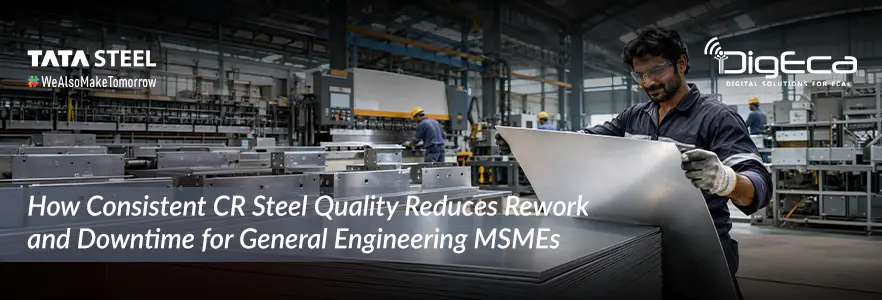
How Consistent CR Steel Quality Reduces Rework and Downtime for General Engineering MSMEs
Consistent cold-rolled steel gives manufacturers a more predictable input for cutting, bending, forming, welding and finishing. Control over thickness, flatness, mechanical properties and surface condition can reduce material-related adjustments and rework. The benefit depends on selecting the right specification and maintaining suitable tooling and process controls.
Rework uses material, labour and machine time that should be producing saleable components. For general engineering MSMEs, repeated bending corrections, surface repairs and assembly adjustments can also disrupt delivery schedules.
Cold rolled steel quality is one factor behind these losses. When incoming material varies beyond what the production process can accommodate, settings that worked for one batch may produce unacceptable results in another.
The aim is to procure steel within defined limits that suit the component and process, then verify that consistency through production records.
Table of Contents
- What Does Consistent CR Steel Quality Mean?
- How Material Variation Creates Rework
- How Rework Leads to Production Downtime
- Is the Problem Material, Tooling or Process?
- What Should MSMEs Specify and Check?
- How to Measure the Production Benefit
- Sourcing Consistent CR Steel Through DigECA
- Buy for Repeatable Production
- Frequently Asked Questions
What Does Consistent CR Steel Quality Mean?
Consistency means that the supplied steel’s relevant characteristics remain within agreed limits, both within a delivery and across repeat orders.
For fabricated panels, brackets, cabinets, housings and other engineering components, the main characteristics include:
How Material Variation Creates Rework
Thickness Variation Changes Fabrication Conditions
Cutting and bending settings are selected for a particular material and thickness range. Changes outside the process’s validated limits can affect edge quality, bend dimensions and fit.
For example, a folded bracket may require correction if its finished dimensions move outside the drawing tolerance. Before changing machine settings, check the actual thickness and the other factors affecting the operation.
Tata Steelium cold rolled steel’s thickness tolerances vary with material thickness, width and specified strength level. Buyers should confirm the applicable tolerance for the ordered product.
Mechanical Properties Affect Forming Behaviour
Two sheets of the same nominal thickness can respond differently during forming if their mechanical properties differ.
Springback, the partial elastic recovery after forming, is influenced by material strength, thickness, geometry and process conditions. Published sheet-forming research identifies strength and thickness variability as contributors to springback variation. This supports checking material properties alongside tooling and settings when bend results change.
The correct response is not automatically a higher drawing grade. Select material properties that suit the component, then establish a process capable of handling the agreed variation.
Shape and Surface Problems Add Corrective Work
Poor incoming shape can complicate positioning and fit-up. Surface damage, corrosion or contamination may require additional preparation or make a visible component unacceptable.
These conditions can arise during manufacture, processing, transport or storage. Inspect incoming material and protect it during handling so that a suitable supplied surface reaches the finishing stage in usable condition.
How Rework Leads to Production Downtime
Rework becomes a downtime issue when normal production stops for investigation, adjustment or replacement material.
A suspected material problem may require operators to stop the machine, segregate components, check stock and run additional trials. Meanwhile, downstream operations may wait for acceptable parts.
The commercial impact extends beyond scrap. It can include:
- Additional setting and inspection time.
- Labour diverted to straightening, rebending or surface repair.
- Interrupted welding or assembly schedules.
- Replacement material and expedited delivery costs.
Consistent input material can reduce one source of this disruption. It cannot reduce manufacturing rework with CR steel caused by maintenance issues, poor planning or unstable processes.
Is the Problem Material, Tooling or Process?
A change in results after a new coil enters production is a useful investigation clue. It is not proof that the steel is defective.
Use a structured check before assigning the cause.
What Should MSMEs Specify and Check?
Begin with the approved component drawing and manufacturing route. Define the grade, applicable standard, dimensions, tolerances, surface requirements and required documentation.
Then agree an incoming inspection plan appropriate to the risk. It may include identification checks, dimensional measurements, surface inspection and review of the mill test certificate.
For repeat orders, control substitutions. A different grade, delivery condition or surface requirement should be reviewed before production use.
Retain material identification after cutting or slitting. Without that link, it becomes difficult to establish whether a recurring problem belongs to one material lot or several production conditions.
How to Measure the Production Benefit
Track performance before and after a procurement or specification change. Useful measures include first-pass acceptance, scrap quantity, rework hours and material-related stoppage time.
Compare similar components under comparable conditions. Record changes in tooling, operators, lubrication or machine settings so that improvements are not incorrectly attributed to steel alone.
Use the results to assess total production cost. A lower purchase price may offer little saving if the material requires more correction, inspection or replacement.
Sourcing Consistent CR Steel Through DigECA
Tata Steelium offers various CR steel grades for general engineering applications. Its product characteristics include cold rolled steel surface finish, consistent mechanical properties and thickness, flatness, formability and weldability.
We recommend comparing these characteristics against your component requirements before ordering through DigECA. Confirm the relevant product specifications and documentation rather than assuming every CR grade will perform alike.
If you need help identifying suitable material, get technical assistance through Ask an Expert on DigECA. Share the component, fabrication process and recurring defect information.
Frequently Asked Questions
Does consistent CR steel guarantee zero rework?
No. Tooling, machine condition, component design and process control also affect results.
Can steel meet its specification and still cause production difficulties?
Yes. The agreed specification may be too broad for the process, or the selected material may be unsuitable for the component.
Which quality measure should an MSME track first?
Start with the main recurring loss, such as rework hours or rejection rate, and connect it to material lots and production records.
Conclusion
Buy for Repeatable Production
Consistent CR steel is valuable when it helps your process produce acceptable parts repeatedly. Define the material limits, verify incoming supplies and investigate defects using both material and process evidence.
Explore Tata Steelium on DigECA with those requirements in place, and assess procurement decisions against production performance as well as purchase price.