
How Corrosion-Resistant Steel Extends the Life of Solar Installations
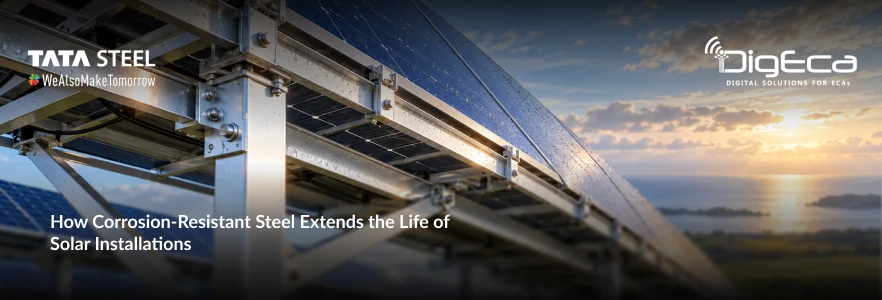
How Corrosion-Resistant Steel Extends the Life of Solar Installations
Corrosion in a solar mounting structure can turn a material-saving decision into a maintenance expense. As rust progresses, members and connections may lose section, require repairs or need replacement. For EPC contractors and fabricators, protection starts with a coating specification that matches the installation’s exposure.
When sourcing corrosion-resistant steel for solar panels in India, assess the supporting structure separately from the modules. Galvano and GalvaRoS offer zinc-coated steel options, but their suitability depends on the component, coating specification and fabrication route.
How Galvanized Steel Protects the Structure
Galvanized steel has a zinc coating that acts as a barrier between steel and the environment. Zinc also corrodes preferentially to steel, providing sacrificial protection at small areas of damage.
This protection has limits. The coating is gradually consumed, and its durability depends on the zinc available and the conditions it faces. Coastal salt, prolonged wetness and poor drainage can increase the demands on the coating.
A suitable coating can delay corrosion of the underlying steel and extend the useful life of mounting components. It does not make the structure corrosion-proof or remove the need for inspection.
Coastal Sites: Account for Salt and Wetness
Coastal installations can face salt deposits, humidity and repeated wetting. Salt retained around joints or sheltered surfaces can create conditions different from those on an exposed, freely draining member.
Specify protection around the actual site exposure rather than distance from the sea alone. Consider drainage, salt accumulation, access for cleaning and the intended service life.
For demanding coastal conditions, assess whether the project requires additional protection, such as a compatible paint system over galvanising. The choice should follow the corrosion assessment and component specification.
Do not select a galvanized steel sheet for a coastal structure solely because it has a zinc coating. Confirm that its grade, coating mass and fabricated condition meet the project requirements.
Humid Sites: Reduce Moisture Retention
Humidity and condensation can keep surfaces wet even without direct rainfall. Overlaps, enclosed sections and poorly drained connections may retain moisture longer than open surfaces.
Alongside coating selection, design the assembly to drain and dry. Avoid details that trap water, and make inspection points accessible.
Storage also matters. Wet sheets stacked closely together can develop wet storage staining before fabrication. Keep material covered, ventilated and protected from trapped moisture, following the supplier’s storage guidance.
Where a galvanized steel coil is used for repeat production, protect it during storage and processing. Inspect the coating before forming so damage is identified before it carries into finished components.
Agricultural Sites: Assess More Than Rainfall
Agri-solar structures may face irrigation spray, soil splash and exposure to fertilisers or other agricultural substances. The effect depends on the substance, concentration and duration of contact.
Check whether components remain above ground, touch soil or are buried. Coating performance in soil varies with factors including pH, drainage and resistivity, so an atmospheric coating assessment alone is insufficient for buried parts.
Keep irrigation discharge away from connections where practical. For areas exposed to agricultural chemicals, assess compatibility with the coating and plan cleaning or additional protection where required.
Galvano and GalvaRoS: What Is the Difference?
| Product | Surface characteristic | What buyers should assess |
| Galvano |
Zero-spangle galvanised plain steel |
Grade, coating mass, surface quality and forming requirements |
| GalvaRoS | Regular-spangle galvanised plain steel | Grade, coating mass, dimensions and fabrication requirements |
Galvano zero spangle galvanized steel offers a uniform zinc coating and a surface suited to applications with appearance and finishing requirements. GalvaRoS has a visible regular-spangle pattern and provides zinc-coated sheets and coils for fabrication applications.
Spangle describes surface appearance. It is not a durability rating. A zero-spangle surface does not automatically provide longer corrosion protection than a regular-spangle surface.
For solar components, compare the actual coating and mechanical specifications. Neither product should be treated as a blanket replacement for every coated member in the structure.
Separate Steel Thickness from Coating Thickness
When specifying galvanized steel thickness, distinguish the base steel thickness from the zinc coating.
The base steel contributes to structural performance, while the zinc coating provides corrosion protection. Each must meet the requirements of the component and its operating environment.
Coating mass may be stated in grams per square metre, often as a total for both sides. Coating thickness may be stated in micrometres. Confirm the reporting basis before comparing quotations.
Likewise, galvanized steel grades describe the steel’s mechanical and forming requirements. A higher-strength grade does not inherently provide better corrosion resistance.
Protect the Coating During Fabrication
Pre-galvanised sheet and galvanising after fabrication are different supply routes. Cutting, drilling and welding pre-coated material can expose steel or damage the surrounding coating.
Specify how cut edges, weld areas and damaged surfaces will be treated. Zinc can protect small exposed areas, but this should not be assumed sufficient for every edge thickness or site condition.
Check bends and formed areas for coating damage during production trials. Use compatible fasteners and review contact between dissimilar metals.
After installation, inspect vulnerable locations such as joints, drainage points and repaired areas. Record coating damage and address it before corrosion spreads.
Procure for the Site and Component
For galvanized steel procurement in India, include the component drawing, grade, base metal thickness, dimensions and zinc coating mass in your enquiry. Also state the fabrication route, site exposure, additional finish, quantity and inspection requirements.
MSMEs looking to buy galvanized steel online can enquire through DigECA. We offer Galvano and GalvaRoS options for assessment against the component specification.
To buy Galvano steel online, share the grade, dimensions and coating requirements. Compare the complete specification and processing cost rather than material price alone.
FAQs
Does galvanized steel prevent corrosion permanently?
No. Zinc delays corrosion of the underlying steel, but the coating is consumed over time. Exposure and coating specification influence durability.
Is zero-spangle steel more corrosion-resistant?
Not necessarily. Spangle is a surface characteristic; compare coating mass, condition and exposure instead.
Can one coating specification cover every solar site?
Only where the exposure assessment supports it. Coastal, humid and agricultural conditions can place different demands on protection.
Does galvanized sheet remove the need for coating repairs?
No. Fabrication and handling can expose steel or damage the coating. Repair requirements should be defined before production.
Conclusion
Corrosion protection works best when the coating matches the site and remains protected through fabrication and installation. Choose between Galvano and GalvaRoS by grade, coating specification and component requirements. Their surface appearance alone does not determine service life.