
Steel for PEB, Purlins and Decking Sheets: Why Their Material Requirements Differ
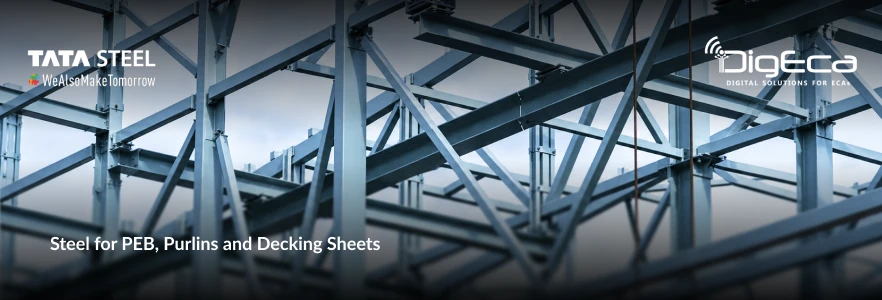
Steel for PEB, Purlins and Decking Sheets: Why Their Material Requirements Differ
A pre-engineered building may use steel in its main frame, purlins and decking, but these components do not perform the same job. Primary members carry the main structural loads. Purlins support the roof or wall system. Decking sheets are formed into structural profiles and may support construction loads, wet concrete or the completed floor system, depending on the design.
One grade, thickness or coating specification cannot be applied across the entire building. Buyers must match the material to the component, fabrication process and service conditions.
Start with the role of each component
The phrase steel for PEB covers several product forms and requirements.
- Primary members include the columns and rafters of the main frame.
- Secondary members include purlins, girts and eave struts.
- Decking sheets serve as permanent formwork or part of an engineered floor system.
Each has a different load path, manufacturing route and exposure condition. The approved structural drawing and project specification must guide the selection.
Steel for primary PEB members
Primary frames require structural steel with the specified strength, elongation and weldability. Fabricators may cut hot-rolled plates or sheets and weld them into built-up sections.
Buyers should verify the grade and standard, thickness and dimensional tolerances, mechanical properties, chemical composition, surface condition and mill test certificate.
Welding matters because long welds and restrained joints can influence distortion and fabrication quality. The welding procedure, consumables, preheat and inspection requirements must suit the grade, thickness and joint design.
When selecting structural steel for PEB, do not replace the specified grade simply because another material has a similar thickness or yield strength. Differences in chemistry, elongation, impact requirements and the applicable standard may affect fabrication or design acceptance. Any substitution should be approved by the structural designer.
Why purlins need a different material approach
Purlins are lighter secondary members, commonly formed into C or Z sections. The steel must provide the required strength while forming consistently through the roll-forming line.
Suitable steel for purlins depends on the specified grade, base-metal thickness, formability, coil width, slit-width accuracy and coating requirement.
Higher-strength material may help achieve the required capacity with a lighter section, but forming capability, connection design, local buckling limits and equipment settings must also be considered.
Purlins below roof sheeting may face condensation, humidity or exposure during erection. Where a project calls for galvanized steel for purlins, confirm the coating specification separately from the base-steel grade. Coating mass, storage, cut edges, fastener compatibility and the installation environment all affect corrosion protection.
What decking sheets must deliver
Decking is thin, profiled material whose performance depends on its grade, thickness, coating and finished geometry. During construction, a deck may serve as permanent formwork and support wet concrete, workers and temporary loads. It may contribute to the completed slab only when designed and installed as part of a composite system.
The correct steel for decking sheets must be roll formed into the approved profile without cracking or unacceptable shape variation. Rib depth, pitch and cover width matter because the finished profile influences performance.
Before ordering, confirm the grade, minimum yield strength, base-metal thickness, coating type and mass, profile geometry, sheet length, span, propping and fastening details.
A decking sheet should not be approved from thickness alone. Sheets of the same nominal thickness can perform differently if their grade, profile, coating or tolerances differ.
Why the same thickness does not mean the same performance
Thickness is only one part of material selection.
For primary members, section geometry and material properties determine capacity and serviceability. For purlins, the formed section, strength, restraint and connections are critical. For decking, the profile, span arrangement and construction-stage loading influence performance.
Asking for “2 mm PEB steel”, “purlin coil” or “deck sheet” leaves out essential information. A complete enquiry for steel for PEB structures should state the component, grade, standard, thickness, dimensions, coating requirement and quantity.
Coated and uncoated steel are not interchangeable
Primary built-up members are commonly made from hot-rolled structural steel and protected using the project’s specified coating system. Purlins and decking may use metallic-coated steel where the design requires it.
However, every secondary component does not automatically need the same coating. Exposure, expected service life, building use and maintenance conditions can change the requirement.
Cutting, drilling, welding and handling can damage a coating. Packs stored with trapped moisture may also develop staining. The material specification must be supported by suitable fabrication, storage and site practices.
What to send with your enquiry
A clear specification reduces clarification cycles and material mismatches. For steel for PEB fabrication, provide:
- Component and end use
- Drawing, grade and standard
- Thickness, width and length
- Coil, sheet or plate requirement
- Base-metal and coating details
- Quantity and delivery schedule
- Welding or roll-forming process
- Project location and service environment
- Test certificate and traceability requirements
For decking and purlins, include the approved profile or slit width. For primary members, state any project-specific toughness, weldability or surface requirements.
Buying PEB steel through DigECA
On DigECA, you can explore Tata Astrum hot-rolled steel for PEB and project fabrication requirements. Available grades, thicknesses and dimensions vary by specification and order requirement, so the approved drawing should remain the starting point.
When submitting an enquiry, include the required grade, dimensions, quantity and delivery location. For coated secondary components, describe the purlin or decking application and add the coating and forming requirements.
Register on DigECA, select the relevant product and grade, and request a quotation with complete project details. This is more useful than a generic request for “PEB steel”.
Frequently asked questions
Can the same steel grade be used for primary members and purlins?
Only if the approved design and specifications permit it. The grade must be verified for each component because their fabrication and performance requirements differ.
Is galvanized steel always required for purlins?
Not in every project. The requirement depends on the design, exposure and specified protection system. Where galvanised material is required, confirm the base-steel grade and coating specification.
Is decking-sheet thickness enough to compare quotations?
No. Compare base-metal thickness, grade, coating, profile geometry, effective cover width and the applicable design information.
What should a PEB fabricator check when steel arrives?
Check the purchase specification, material identification, mill test certificate, dimensions, surface condition and traceability. Also verify coated material against the required coating specification.
Conclusion
The main frame, purlins and decking sheets work together, but their material requirements are not identical.
Primary members demand structural strength, weldability and traceability. Purlins require strength, formability, dimensional control and corrosion protection. Decking sheets depend on grade, coating, thickness and precise profile geometry.
Start with the approved design, define the role of each component and order the corresponding material. That is the foundation of reliable steel for PEB fabrication.