
Steel That Works as Hard as Your Farmers: A Guide to Agri Equipment Manufacturing
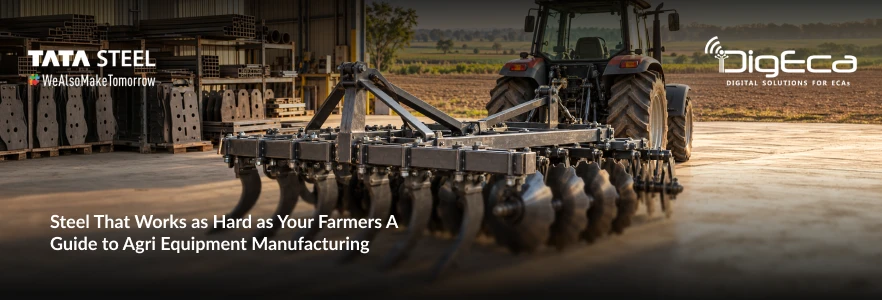
Steel That Works as Hard as Your Farmers: A Guide to Agri Equipment Manufacturing
A plough frame must hold its shape as the implement moves through uneven soil. A tiller blade must withstand repeated contact with the ground. An irrigation fitting must maintain a sound joint under its specified operating conditions. Each application places different demands on steel.
For MSMEs sourcing steel for agriculture equipment manufacturing in India, the starting point is the component drawing, its working conditions and the fabrication process. This guide explains how to assess hot rolled steel grades for farm machinery, with a focus on Tata Astrum and practical checks before procurement.
Match the Steel to the Component
Farm machinery combines load-bearing structures, formed parts, wear components and assemblies exposed to moisture. Using one grade throughout may simplify purchasing, but it can leave individual parts poorly suited to their work.
Before selecting steel for farm machinery manufacturing, establish:
- Loads: Include working loads, vibration, repeated loading and occasional impacts.
- Wear: Identify parts that cut, scrape or remain in contact with soil.
- Fabrication: Confirm cutting, bending, welding and any heat treatment.
- Exposure: Consider rain, mud, fertilisers and the planned protective finish.
Strength, hardness and toughness describe different properties. A grade suitable for a welded frame may not provide the hardness required for a soil-cutting blade.
Which Hot Rolled Steel Grades Should You Assess?
Tata Astrum covers mild and higher-strength hot rolled products for multiple applications, including agriculture. Our agriculture range on DigECA includes IS 2062 E250 and E300 options, alongside other specifications. The complete grade, subgrade and thickness must match the approved requirement.
Use the following as a starting point for technical assessment, rather than a substitute for the equipment specification.
| Component requirement | Grade or material category to assess | Key check |
| General welded brackets, supports and frames |
IS 2062 E250, where specified |
Strength, thickness and weld details |
| More heavily loaded structural parts | E300, E350 or another approved higher-strength grade | Design calculations, fatigue and fabrication requirements |
| Soil-cutting blades and replaceable wear parts |
Specified wear-resistant or heat-treatable steel |
Hardness, toughness and heat treatment |
|
Formed or welded irrigation components |
Material specified for the component and service |
Formability, joint quality, pressure and corrosion requirements |
When comparing Tata Astrum steel grades for agricultural equipment, retain the full specification. Grades with similar strength labels may differ in chemistry, impact requirements or delivery conditions.
Tractors and Implements: Balance Strength with Fabrication
Tractor-mounted implements use frames, mounting plates, brackets and reinforcing parts to transfer loads. Selecting HR steel for tractor implements requires attention to how those loads pass through the assembly, particularly around holes, welds and changes in section.
E250 may suit general fabricated components where the drawing specifies it. Higher-strength grades such as E350 may be considered where calculations call for greater load capacity. Tata Astrum includes E350 options, but suitability depends on the component specification and selected thickness.
Higher yield strength does not automatically justify a thinner sheet. Stiffness, buckling, fatigue, weld performance and mounting details still require review. Any thickness reduction should follow design approval and appropriate validation.
Ploughs and Tillers: Separate Frame Requirements from Wear Requirements
Plough and tiller assemblies illustrate why hot rolled steel for agricultural equipment must be selected part by part.
A welded frame requires suitable structural properties and fabrication performance. A share, tine or rotary blade may also require a specified hardness and heat treatment to withstand soil abrasion and impact.
Do not extend a frame-grade recommendation to every working part. Confirm the blade or tine specification separately, including any requirements after forming and heat treatment.
For bent structural parts, check the permitted bend radius, rolling direction and edge condition. A material that performs well in a flat bracket may require different tooling or process settings when formed into a tighter shape.
Irrigation Fittings: Check the Service Conditions
Irrigation equipment includes pump supports, mounting brackets, pipe assemblies and fittings. Their material requirements vary considerably.
For fabricated supports, structural strength and weldability may guide selection. For water-carrying components, assess the applicable product standard, pressure rating, leak tightness and corrosion protection.
An HR coil used to manufacture a tube is raw material for a further production process. It does not establish the performance of the finished pipe or fitting.
Where components face regular wetting, specify surface preparation and a suitable protective system. General structural HR steel should not be treated as corrosion-resistant solely because it has adequate strength.
Weldability Matters Across the Assembly
When choosing hot rolled steel for fabrication, review weldability alongside strength. A frame can meet its material specification and still perform poorly if joint design, preparation or welding practice is unsuitable.
Check the mill test certificate for the supplied chemistry and review carbon equivalent where relevant to the welding procedure. Section thickness, joint restraint, consumables and heat input also affect welding decisions.
Tata Astrum’s product documentation covers chemical and mechanical testing and grade-specific delivery requirements. Use these details to assess the selected material against the fabrication specification.
Do not assume every grade can use the same welding procedure. Confirm whether preheating, controlled consumable storage or additional inspection is required for the assembly.
Use Technical Assistance Before Committing to a Grade
A recurring weld defect, cracking during bending or uncertainty over grade selection is worth resolving before placing a repeat order.
Through DigECA’s Technical Assistance service, you can seek guidance from Tata Steel specialists on grade selection, process upgrades and quality issues. Our Ask an Expert feature also covers steel grades, bending and forming, welding and coating processes.
Share the component drawing, current grade, thickness, process details and photographs of the issue. These give the discussion a practical starting point.
Prepare a Clear Purchase Requirement
MSMEs looking to source hot rolled steel for agricultural equipment online should confirm the complete specification before comparing quotations.
Include the standard, grade, subgrade, thickness, dimensions, quantity, delivery location and documentation requirements. Specify whether the workshop requires coils or sheets, based on its cutting equipment, handling capacity and production volume.
Through DigECA, you can buy hot rolled steel sheets online in India and connect with authorised Tata Steel distributors. Confirm product availability and delivery terms for your requirement before finalising the order.
FAQs
Which steel grade suits agricultural equipment?
There is no single grade for every component. Structural parts may use specified IS 2062 grades, while blades, tines and other wear parts can require different materials and heat treatment.
Can higher-strength HR steel reduce equipment weight?
Potentially, where the design permits a thinner section. Strength alone is insufficient; stiffness, fatigue, buckling and joint performance must also be checked.
What should I check before ordering Tata Astrum?
Confirm the complete grade, thickness, dimensions, fabrication requirements and mill test certificate requirements against the approved drawing.
Conclusion
Reliable agricultural equipment starts with steel selected for each component’s loads, fabrication process and working conditions. Assess structural grades, wear materials and corrosion protection separately. To buy Tata Astrum hot rolled steel online, share your requirement with us on DigECA and seek technical guidance where the specification requires clarification.