
What Every PEB Fabricator Must Verify on a Hot Rolled Steel Mill Test Certificate
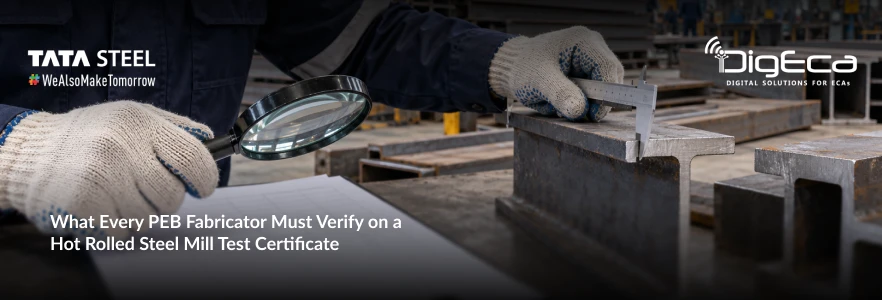
What Every PEB Fabricator Must Verify on a Hot Rolled Steel Mill Test Certificate
A plate can match the required thickness and still be the wrong material for a PEB frame. The grade may differ from the drawing, the heat number may not match the certificate or an important test result may be missing.
These problems are difficult to detect once the steel has been cut and welded. The Mill Test Certificate, or MTC, gives fabricators a way to verify the material before production begins.
For buyers of hot rolled steel for PEB projects, checking the MTC should form part of material receipt, not remain a paperwork exercise completed after fabrication.
What does a Mill Test Certificate confirm?
An MTC records the identity and tested properties of a batch of steel. It connects the delivered material to its manufacturing and test results through a heat or cast number.
For steel for PEB structures, the certificate can confirm:
- Manufacturer and certificate details
- Material standard and grade
- Heat or cast number
- Product form and dimensions
- Chemical composition
- Mechanical test results
- Quantity covered by the certificate
- Applicable certification or inspection details
The certificate must be read alongside the purchase order, approved drawing and markings on the physical material. None of these should be checked in isolation.
Match the heat number to the material
The heat or cast number provides traceability back to the batch from which the steel was produced. It is one of the most important details on the MTC.
Check that the number on the certificate matches the marking on the plate, sheet, coil or bundle. If several heat numbers arrive in one consignment, each batch should have corresponding documentation.
Do not combine unidentified material with verified stock. Once plates are cut into smaller parts, maintain traceability through piece marking, job cards or an internal material identification system.
This matters particularly for PEB primary members, where columns, rafters and built-up sections become part of the main load-carrying frame.
Confirm the complete grade designation
Check the material standard, grade and subgrade against the approved drawing and purchase order. A partial match is not enough.
The certificate should not simply say “structural steel” or use a broad commercial description. It must carry the grade designation required for the project.
Different hot rolled steel grades offer different levels of strength, ductility and fabrication performance. Two materials with similar dimensions are not automatically interchangeable.
If the delivered grade differs from the drawing, stop the material from entering production. Any substitution must be reviewed and approved by the authorised structural designer or project consultant.
Verify the product and dimensions
The MTC should describe the product form covered by the test results, such as plate, sheet or coil. Check the stated thickness and other dimensions against the purchase order.
This document check should be supported by a physical inspection. Measure the received material according to the project’s inspection procedure and confirm that it falls within the permitted tolerances.
For built-up structural steel for PEB frames, thickness directly affects the member’s load capacity, weight, welding requirement and fit-up. A certificate showing the correct grade cannot compensate for material supplied in the wrong size.
Also confirm that the quantity or weight covered by the certificate is consistent with the consignment received.
Review the chemical composition
The chemical composition section records the tested levels of elements present in the steel. Depending on the standard and grade, this can include carbon, manganese, sulphur, phosphorus, silicon and other specified elements.
Fabricators do not need to interpret the chemistry as metallurgists. The practical check is whether the reported values comply with the required standard and project specification.
Chemistry can influence weldability and fabrication behaviour. If the project or welding procedure places limits on carbon equivalent or individual elements, confirm those requirements before cutting begins.
This is especially important when hot rolled steel for fabrication will undergo extensive welding across primary-frame sections.
Check the mechanical test results
Mechanical properties describe how the tested material responded under load. The MTC commonly records:
- Yield strength
- Tensile strength
- Elongation
- Bend-test results, where applicable
- Impact-test results, where required
Compare the reported results with the requirements of the specified grade. Do not approve the material simply because the values appear high. The certificate must correspond to the correct standard, grade, thickness and heat number.
Impact-test information may be required for a particular subgrade or service condition. If the drawing or project specification calls for it, confirm that the result and test temperature are recorded.
Treat primary and secondary members separately
The MTC review should follow the role of the material within the building.
For primary frames, verify the structural grade, thickness, mechanical properties, weldability-related requirements and heat traceability. These directly affect the performance of columns, rafters and built-up sections.
PEB secondary members such as purlins and girts are often made from thinner cold-formed steel. Their material documents may require checks for base-metal grade, thickness, coating and section-specific requirements.
Do not use the MTC for a primary-frame plate to approve secondary-member material, or vice versa. Each package should be verified against its own bill of materials and approved specification.
Check whether the certificate is complete
A usable MTC should be legible and clearly connected to the supplied material. Check for:
- Certificate number and date
- Manufacturer identification
- Applicable standard and grade
- Heat or cast number
- Test results
- Product dimensions and quantity
- Authorised certification or approval details
- Unexplained corrections or missing fields
A blurred scan, manually altered value or certificate without traceable material markings should be held for clarification. Do not rely on a supplier invoice as a replacement for the MTC.
Complete the physical inspection as well
An MTC confirms tested material properties. It does not confirm the present condition of every plate or sheet in the yard.
Inspect the consignment for visible damage, heavy rust, edge defects, lamination indications, distortion and incorrect dimensions. Confirm the received quantity and keep different heats or grades properly identified during storage.
Document any mismatch before the material enters production. This creates a clearer record if the supplier needs to replace or clarify the consignment.
Source Tata Astrum HR steel through DigECA
On DigECA, you can explore Tata Astrum grades suited to PEB and project fabrication requirements. Review the available specifications, register on the platform and raise an enquiry for a quotation based on the grade, dimensions, quantity and delivery location you require.
If you want to buy hot rolled steel MSME online, state the complete material designation from the approved drawing. Avoid raising an enquiry for generic “HR sheet” or “PEB steel” without the required grade and dimensions.
Frequently asked questions
What is a Mill Test Certificate for hot-rolled steel?
It is a document that records the identity, grade, chemical composition and mechanical test results of a batch of steel.
What is the most important number to check on an MTC?
The heat or cast number is central to traceability. It should match the marking on the physical material.
Is an MTC enough to approve steel for fabrication?
No. The certificate must be checked against the purchase order, approved drawing and physical material. Dimensions and visible condition should also be inspected.
Can a different steel grade be accepted if its strength is similar?
Only after approval from the authorised structural designer or project consultant. Similar strength does not make two grades automatically interchangeable.
When should a PEB fabricator check the MTC?
Check it when the material is received and before cutting, welding or issuing the steel to production.
Conclusion
An MTC is useful only when it remains connected to the material it certifies. Verify the grade, dimensions, heat number and test results before fabrication, then preserve that traceability as plates are cut into individual components.
A few checks at material receipt can prevent the wrong steel from becoming part of a completed PEB frame.