
Why High-Quality Steel Matters in Solar Installations
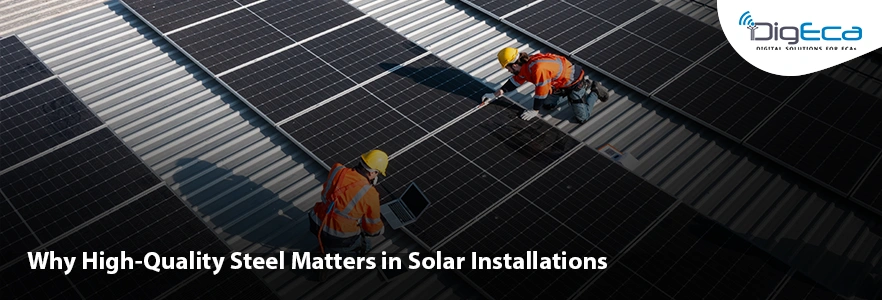
Why High-Quality Steel Matters in Solar Installations
Most conversations around solar energy start and end with the panels: wattage, efficiency, price per unit—all valid concerns. But here’s what often gets left out: none of that matters if the structure underneath isn’t solid.
The solar panel mounting structure material is what holds everything together—literally and financially. It’s the silent partner in every solar project. If you compromise there, you're not just cutting corners. You're risking long-term performance, safety, and the overall return on your investment.
Let’s break down why high-quality steel is one of the smartest and most overlooked choices in solar infrastructure.
The Role of Mounting Structures in System Integrity
The metal framework beneath your panels isn’t just supporting weight. It’s absorbing stress from wind, handling expansion and contraction from daily temperature shifts, and surviving years of exposure to moisture, dust, salt, and pollution.
If that frame fails, everything fails.
That’s why selecting the right structural steel material is critical. Cheap, low-grade steel might look fine on day one. But give it five years—and a few monsoon seasons and you’ll start seeing the cost of cutting costs.
Rust. Warping. Loosened bolts. Misaligned panels that no longer catch optimal sunlight. Even minor tilts can reduce output by 2–3% annually. In a system designed to last 25–30 years, that’s a serious hit.
Understanding the Different Types of Steel for Solar Use
There are many types of steel, and they’re not interchangeable.
For solar installations, two grades often used are S235 and S355. Both are examples of high-strength steel, but S355 offers even more load-bearing capacity, making it ideal for high-wind or high-snow regions. It’s the difference between "this might hold" and "this will hold, even when conditions get rough."
These steels are part of a broader family of structural steel materials engineered for strength, ductility, and consistency. That last one matters. Because in a solar farm, you don’t want surprises. You want predictability. You want performance.
Corrosion Resistance and Environmental Longevity
If there’s one silent killer of solar infrastructure, it’s corrosion. Steel that isn’t properly protected, especially in humid, coastal, or industrial areas, starts breaking down from day one.
That’s why galvanisation matters. The best quality steel for solar isn’t just stron,g it’s protected. Hot-dip galvanising, where steel is coated in a layer of zinc, creates a barrier that shields the metal from moisture and pollutants. The thickness of this zinc coating (measured in microns) directly affects how long the structure resists rust.
In coastal areas? Go thicker. You need a zinc layer that meets or exceeds ISO 1461 standards. Some projects may even require components in especially harsh environments.
Why does this matter? Because once rust sets in, it doesn’t stop. And it doesn’t just make the structure unappealing, it weakens joints, loosens bolts, and threatens the alignment of every panel.
Consequences of Poor Steel Choices
Earlier this year, several solar installations across Madhya Pradesh were severely damaged during a storm. Wind speeds reached 120 km/h, a serious but not unheard-of event.
The cause of failure? Not the panels. Not the wiring. It was the solar panel mounting structure material. Cheap steel, poor galvanisation, zero traceability. Entire rows of panels collapsed. The cost of replacing them dwarfed any savings made by choosing budget steel.
This isn’t a one-off story. Across India, as solar capacity expands, EPCs and developers are learning this the hard way: types of steel matter. It’s not enough to just install solar—you have to install it to last.
Steel vs. Aluminium: Material Trade-offs for Mounting Systems
Some developers consider aluminium for its corrosion resistance and lower weight. But here’s the tradeoff: aluminium lacks the tensile strength of high-strength steel, and it expands more in heat. That means more movement, more stress on joints, and a greater risk of misalignment over time.
For large-scale installations—especially ground-mounted ones—structural steel material remains the preferred choice. It’s stable, predictable, and with the right coating, just as corrosion-resistant.
In short, you’re not just buying metal. You’re buying stability.
Evaluating Lifecycle Costs and Performance Metrics
It’s tempting to focus on upfront costs. But solar isn’t a six-month project. It’s a 25-year asset. That means your materials need to deliver value over decades.
Using the best quality steel with proper galvanisation might cost a little more on day one. But you’ll make that money back in:
- Fewer structural repairs
- Reduced panel misalignment
- Higher energy yields
- Longer life for the entire system
Solar developers often plan around “Levelized Cost of Energy” (LCOE)—basically, the cost to produce each unit of power over time. When your steel fails early, your LCOE goes up fast.
Industry Standards and Compliance Requirements
If your steel supplier can’t provide mill test certificates, galvanisation specs, or compliance with global standards, that’s a red flag. These documents aren’t bureaucratic red tape—they’re proof that the material will perform as promised.
Look for compliance with:
- IS 2062 (India)
- ASTM A36 (US)
- ISO 1461 (galvanisation)
Don’t assume. Ask. And verify.
Managing Thermal Expansion for Structural Stability
Even a slight misalignment, say, from a warped frame or expanded joint, can throw off your panel’s tilt. That means less sun captured, less power generated, and lower efficiency overall.
Solar is precise. Your frames need to be too.
Using high strength steel ensures minimal deformation under pressure and predictable expansion under temperature swings. Over the years, this adds up to more consistent output and fewer headaches.
Sustainability Considerations and Recyclability
There’s another upside: steel is one of the most recyclable construction materials out there. When sourced from responsible suppliers using electric-arc furnaces (EAF), the carbon footprint is significantly lower than traditional primary steel production or aluminium.
So, using the best quality steel doesn’t just help your project—it helps the planet.
Choose Steel That’s Built to Last
Here’s what all of this comes down to:
Your solar system is only as strong as what it stands on.
Choosing the right solar panel mounting structure material is about more than specs. It’s about foresight. It’s about avoiding failure five or ten years down the line. It’s about protecting your investment, your reputation, and the people depending on that power.
If you’re planning a solar project:
- Know your steel grades. Look for S235, S355, or equivalents.
- Choose high-quality galvanisation. Don’t skimp on coatings.
- Ask for documentation. Standards matter more than sales pitches.
- Match the steel to your site. Coastal? Go stainless or max galvanisation.
- Think beyond costs. Think in terms of energy output, maintenance load, and years of service.
Conclusion
Strength That Supports Solar Success
There’s no glamour in steel beams and bolts. They don’t make the headlines. But they’re the reason your panels stay upright, aligned, and productive year after year.
So don’t treat the solar panel mounting structure material like an afterthought. Treat it like what it really is: the foundation of your system’s success.
Because when it comes to solar, strength isn’t just above the ground—it’s built into it.