
The Importance of Cold Rolled Steel in Modern Construction
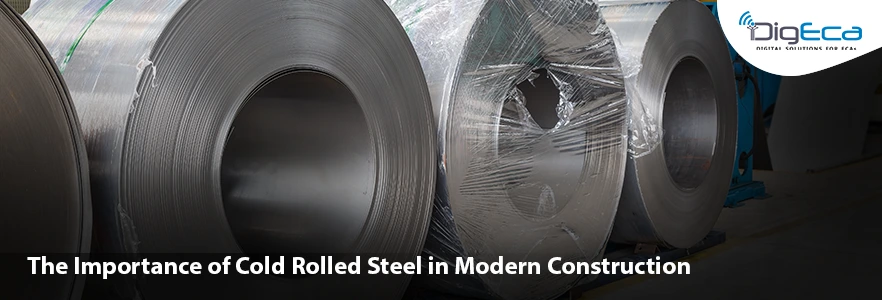
The Importance of Cold Rolled Steel in Modern Construction
Steel has been a pillar of construction, and due to improvements in material technology, cold-rolled steel has become one of the most dependable options for contemporary works. This material is compelling, smooth, and can be used in a variety of things since it is used in skyscrapers and residential complexes, as well as industrial facilities and architecture. To the engineers, architects, and contractors, it is imperative to know how cold-rolled steel can be used in construction in a bid to attain durability and accuracy in the current fast-changing infrastructural world.
What is Cold Rolled Steel?
Cold-rolled steel is manufactured by processing hot-rolled steel further at room temperature through a series of rolling mills. These secondary operations, besides providing it with a clean surface finish, are also beneficial in terms of dimensional accuracy and structural integrity. The outcome is a product with tighter tolerances, hardness of cold-rolled steel, and the ability to be used in several construction applications.
Advantages of cold-rolled steel
These performance-oriented properties of cold-rolled steel have led to its wide use. Cold-rolled steel has the following main advantages:
High Quality Strength and Hardness:
Cold rolling makes steel very tough and therefore very wear-resistant. This is a property that performance is long-lasting in construction projects that are subjected to heavy loads and stresses.
High Dimensional Accuracy:
Cold-rolled steel has accurate dimensions and thickness as opposed to hot-rolled steel. This is of particular concern to architectural projects that require accuracy and consistency.
Enhanced Surface Finish:
Cold-rolled steel possesses burnished, clean, and smooth surfaces, making it applicable in areas that consider looks. This saves the finishing processes that may be required before painting or coating.
Improved Formability:
In spite of its power, cold-rolled steel is easy to bend, cut, or form into different profiles. This renders it flexible in a host of construction applications.
Resistance to Deformation:
Cold-rolled steel is hard and thus remains in shape when subjected to stress, giving structural integrity to high-rise and industrial frameworks.
Cold-rolled steel in Construction
The contemporary building industry requires materials that have the capability of providing strength, accuracy, and durability. Cold-rolled steel fits these requirements in various industries:
High-Rise Buildings:
Cold-rolled steel has an excellent strength-to-weight ratio, which ensures that it holds the load of high buildings, and the design remains flexible.
Housing and Business projects:
All-cold-rolled steel is ubiquitous in wall studs, roofing systems, and floor decks, which offer good stability of the structures and their appearance.
Industrial Applications:
Factories, warehouses, and workshops use cold-rolled steel as their strong structures, mezzanines, and machine floors.
Elements of Architecture Design:
The cold-rolled steel is employed in contemporary aspects of the facade, decorative panels, and interior designs because of its malleability and smoothness, which enables it to look functional and beautiful at the same time.
Infrastructure Projects:
The cold-rolled steel provides safety and a long-life span performance of bridges, transport hubs, and public utilities due to its durability and precision in dimensions.
Steel Hardness and Effect on Cold Rolled Steel
Hardness is one of the characteristics of cold-rolled steel. The cold rolling process makes the steel stronger and more resilient than the hot-rolled one. This property is essential in contemporary construction due to the following reasons:
Load-Bearing Capacity: Harder steel gives more support, whereby buildings are in a position to take heavy loads and environmental stresses.
Safety Assurance: Hardness is enhanced to reduce wear and tear, hence reducing the chances of structural failure.
Strength in Adverse Environment: City pollution to industrial applications, cold-rolled steel is of considerable strength even at extreme conditions.
Cost-Efficiency in the Long Run: At a higher cost can be incurred at the beginning, but repairs and replacement are less frequent with cold-rolled steel; thus, it is more cost-efficient in long-term projects.
Sustainability and Current Construction Requirements
With the recent trend towards sustainability in the construction industry, such materials as cold-rolled steel can be highlighted as more recyclable and less wasteful. The high-quality cold rolling technologies applied to Tata Steel provide the company with a chance to not only approach the global quality standards of the material but also respond to environmentally friendly activities. As developers use cold-rolled steel, they make the projects greener without having to sacrifice performance.
The Future of Construction with Cold-Rolled Steel
The development of building needs stronger, more innovative, and more sustainable materials. Cold-rolled steel checks all these boxes:
- It offers the power and firmness required in massive works.
- It provides accuracy and consistency of complicated building designs.
- It is in line with sustainability, with recyclability and efficiency.
To a modern builder, contractor and developer, cold-rolled steel is not simply a material; it is a solution that will allow innovation and longevity in all buildings.
Conclusion
Cold-rolled steel has its role to play in building construction, and this role cannot be overemphasized. It is the best material because of its hardness, dimensional precision and finishing smooth, thus essential in the modern high-performance infrastructure works. Cold-rolled steel is used to provide the stability, power and permanency required to construct the future through skyscrapers, industrial centers, as well as the beauty of architectural works.
At DigECA by Tata Steel, we believe in empowering industries with the best steel solutions so that all projects remain firm over the decades.